
In marketing communication and sales conversations, the term “digital twin” is often used interchangeably with a static 3D model. This simplification has real consequences: the two solutions differ not only in definition, but in scope of functionality, implementation cost, and how the data can be used operationally. The distinction between a visualisation and a genuine digital twin determines what tasks a model can actually perform — and what budget needs to be allocated for it.
3D Model / Visualisation: A Static Record of an Object’s State
A 3D model — whether a point cloud, mesh model, or CAD model — shows what an object looked like and what dimensions it had at specific time it was scanned. It’s a snapshot: accurate and useful, but static. If changes were made at the plant, the model does not change until someone manually updates it.
A visualisation answers the question: what does this object look like, and what are its dimensions?
Digital Twin: A Model Connected to Reality
A digital twin starts from the same point as the 3D model but adds something a static model lacks: a continuous stream of operational data from the real-world object, such as temperature, pressure, or vibration sensor readings. It’s worth emphasising that a change to the physical structure (e.g., an added pipeline) requires a re-scan or manual model update in both cases. The difference is that a digital twin continuously reflects the state and behaviour of the object within the existing geometry, allowing you to observe, diagnose, and sometimes even predict its behaviour without a person having to manually input that data.
A digital twin answers a different question: what is happening with this object right now, and what should we do about it?
Is Every 3D Visualisation a Digital Twin?
No. This is the most common mistake in marketing communication around this technology. A 3D model alone — no matter how precise or nicely visualised — doesn’t become a digital twin just because we call it one. The key factor is a connection to operational data in real time (or near-real time); without that, what you have is a static model, regardless of what we call it.
This distinction has practical significance: when ordering a “digital twin,” it’s worth clarifying upfront whether you’re expecting just a precise model, or a system that continuously receives data from sensors installed on the equipment (e.g., temperature, pressure, vibration) and connects with systems such as SCADA or computerised maintenance management software (CMMS). The latter requires not only a 3D model, but also physical measurement infrastructure, IT integration, and its ongoing maintenance — hence a completely different scope of work and budget than a static 3D model without an operational data layer.
What This Looks Like in Industrial Practice
The path from laser scanning a facility to a full digital twin isn’t a single leap but a series of stages, with each stage being a standalone, useful product, not just a stop on the way to something else.
WebPano — our browser-based platform — plays a key role in this process, making scans, 360° panoramas, and 3D models accessible from anywhere, on any device, without needing to install CAD software or hold specialised licences.
Stages of Digitalisation Advancement
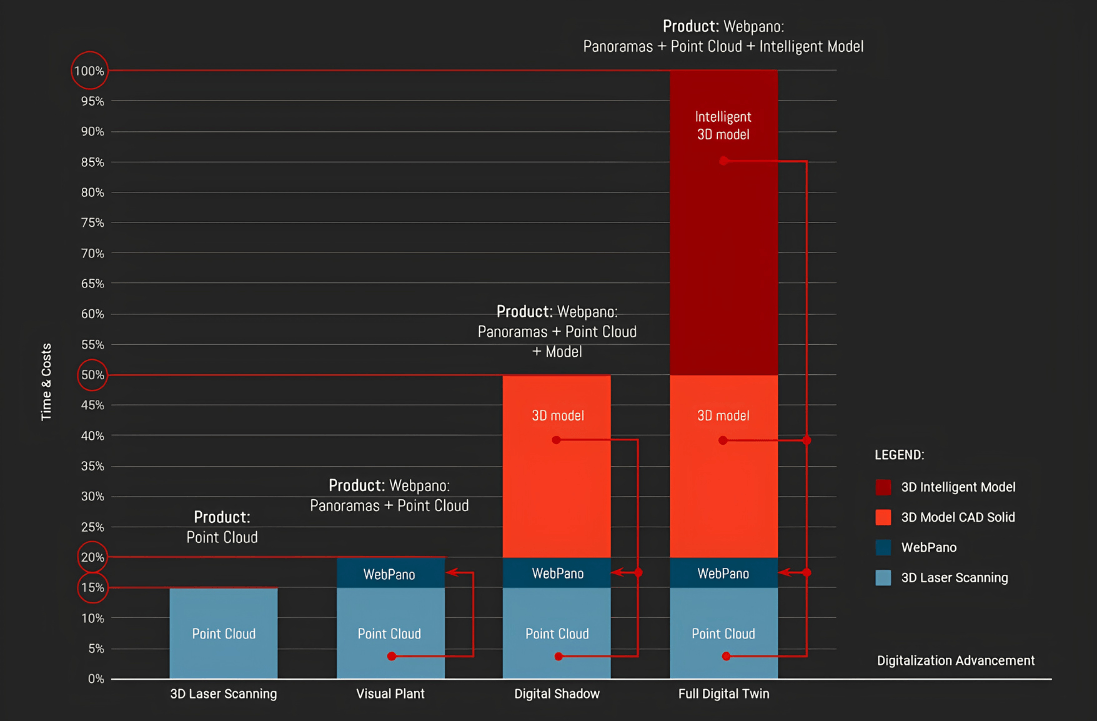
- 3D Laser Scanning — the starting point: a point cloud, a precise record of the object’s geometry at a given moment.
- Visual Plant — a point cloud shared via WebPano: the whole organisation gets access to the data without CAD licences or software installation.
- Digital Shadow — a full 3D (CAD) model built from simple solids is added to the point cloud. This model can later serve as the foundation for an intelligent model enriched with the appropriate information layer.
- Full Digital Twin — an intelligent model connected to data from sensors and systems such as SCADA or CMMS, allowing the object’s condition to be observed and analysed continuously. In practice, at 3Deling this means connecting to the client’s existing measurement infrastructure (or implementing it in partnership with a specialised partner) — not building a SCADA system from scratch. CMMS integration also requires individual adaptation to the client’s specific IT environment. So this isn’t a ready-made, “off-the-shelf” solution, but an integration project tailored to a particular environment.
These stages are progressively more expensive and time consuming, but each one, on its own, also addresses different business needs. You don’t need to reach the final stage for digitalisation to be worthwhile: simply sharing the point cloud via WebPano already enables virtual site visits, online measurements, and integration with operational processes.
What’s more, WebPano is a platform that can be customised. Our IT team can expand it to fit a client’s specific needs and add new functionality. WebPano gets your team exactly what they need for their particular process, rather than limiting them to a fixed, closed set of options, as is the case with similar platforms. This is an intermediate solution: it doesn’t require full integration with SCADA-class systems yet goes well beyond static visualisation.
When Visualisation Is Enough, and When You Need a Full Digital Twin
A static 3D model is enough when you need documentation of an object’s current state, you’re planning a one-time modernisation, or you want insight into geometry without incurring the cost of sensor integration.
A full digital twin makes sense when you need continuous monitoring of the facility’s condition, you want to predict failures before they occur, or you manage an object where changes happen frequently enough that a static model quickly becomes outdated.
Wondering which solution best fits your plant’s requirements? We’ll help you determine the right scope for your needs.