
The digitalization of industrial plants is increasingly based on 3D laser scanning and the creation of a virtual representation of existing assets. Point clouds, 3D models, and integration with technical documentation (such as P&ID diagrams) have become the foundation for modernization projects, maintenance operations, and technical knowledge management.
However, for a digital twin of a plant to be reliable, consistent, and useful over the long term, one essential element is often underestimated at the planning stage: the control network.
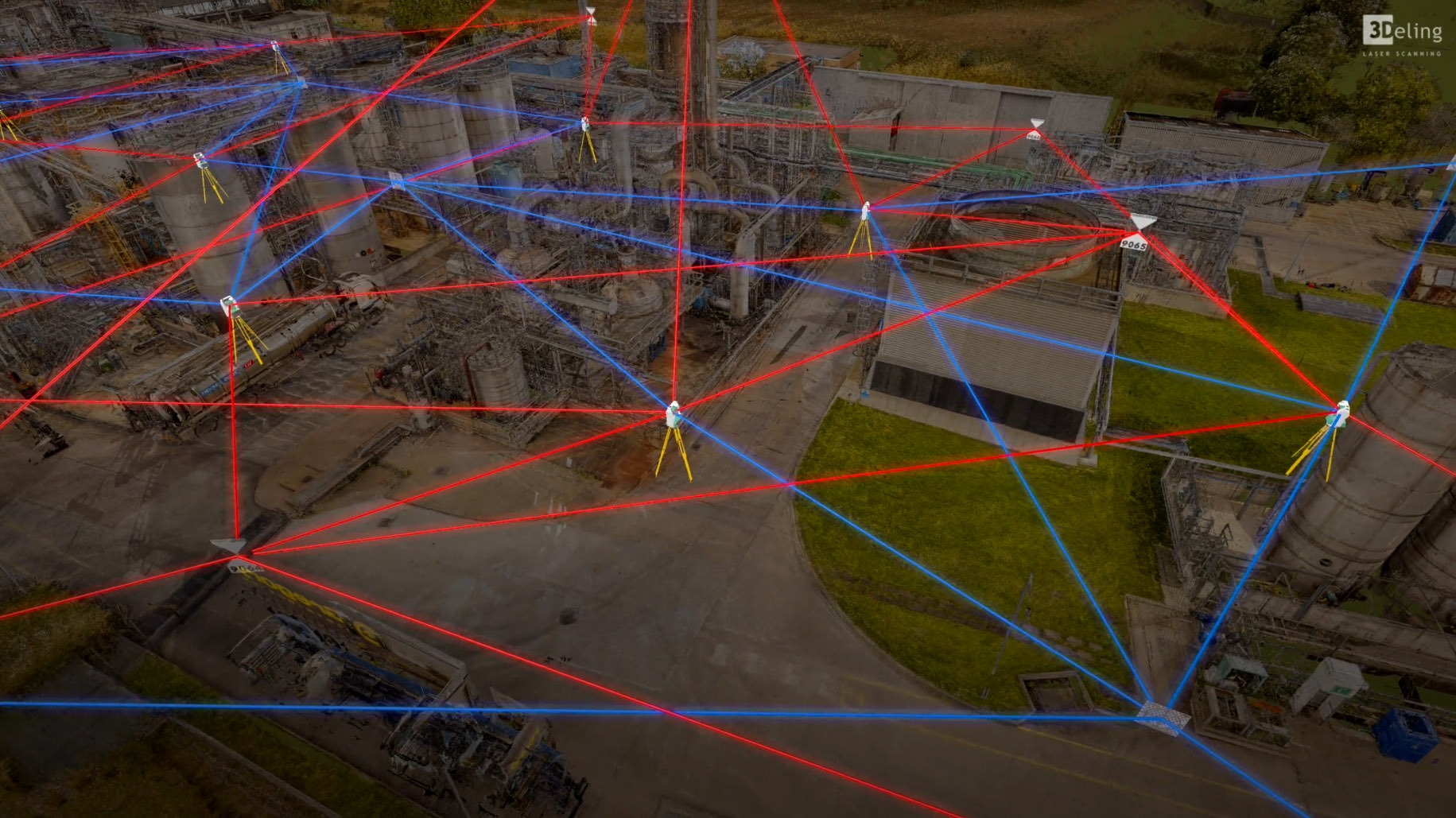
Control network and distribution of 3D laser scanning positions within an industrial plant
What is a control network in the context of plant digitalization?
A control network is a set of stable reference points whose positions are precisely defined within an adopted coordinate system, together with information about their accuracy. In practice, it forms the physical reference framework to which all measurements within the plant are related.
In the context of digitalization, this means that the control network:
-
defines the geometry and scale of the entire digital documentation,
-
allows data from different laser scanning campaigns to be combined,
-
enables the integration of point clouds, 3D models, and technical drawings.
Without a properly designed control network, even the highest-quality 3D laser scanning data loses much of its practical value.
Why is a control network critical for 3D laser scanning?
3D laser scanning generates vast amounts of data in the form of point clouds. For this data to be:
-
combined into a coherent dataset,
-
compared over time,
-
used in modernization and expansion projects,
it must be referenced to a single, consistent coordinate system.
The same reference system can then be used not only for as-built surveys, but also for setting out newly designed objects in the field. This ensures that inventory data, design documentation, and construction activities all refer to the same control network, eliminating discrepancies between existing conditions, design intent, and actual positioning on site.
In practice, this significantly reduces interpretation errors, ambiguities in project positioning, and situations where responsibility for inconsistencies becomes blurred between the survey team, designers, and construction contractors.
The control network as the “skeleton” of a digital plant twin
The control network therefore acts as the structural backbone of a digital plant twin. Thanks to it:
-
subsequent stages of digitalization can be implemented gradually,
-
data collected over different years remains compatible,
-
changes within the facility can be measured and clearly quantified.
This is particularly important in industrial plants, where digitalization is a long-term process, not a one-off project.
A local control network tailored to the digital plant
In industrial plant digitalization projects, a local control network is most commonly used. While it may be linked to a national coordinate system, it is optimized for the specific needs of the facility.
This approach offers tangible benefits:
-
software used for point cloud processing and 3D modeling works most reliably when objects are described using low, positive coordinates, i.e. relatively small numerical values measured in meters from a local origin,
-
the coordinate system can be aligned orthogonally with building and installation axes,
-
data becomes more intuitive for designers, engineers, and maintenance teams.
A well-designed control network makes digital documentation easier to use and simpler to expand in the future.
Data stability today and in the future
One of the main objectives of plant digitalization is to preserve and organize technical knowledge, especially in the face of staff turnover and organizational change.
A control network:
-
ensures consistency between historical and current data,
-
enables comparisons of the facility’s condition at different points in time,
-
provides a reference framework for future modernization, expansion, and analysis.
As a result, the digital plant twin is not a static archive, but an active tool supporting everyday technical decision-making.
The control network as the basis for integration with technical documentation
The full value of a digital plant twin emerges when 3D data is integrated with:
-
CAD and CAE documentation,
-
technological diagrams such as P&IDs,
-
operational and maintenance information.
The control network enables this integration by ensuring that all elements refer to one consistent spatial reference system. This translates into:
-
faster preparation of modernization projects,
-
better communication with design companies,
-
reduced risk of execution errors on site.
Summary: why digitalization should start with a control network
A control network is not an optional addition to plant digitalization—it is its foundation. It determines whether:
-
data from different time periods remains compatible,
-
point clouds become a practical design support tool,
-
the digital plant twin remains useful for many years.
When planning 3D laser scanning and the creation of a virtual representation of an industrial plant, it is worth starting with a simple question:
Do we have a solid reference framework for all our data?
The control network is one of the key elements affecting data quality in the digitalization process, but it is not the only one. In the following articles, we will show how factors such as the number and distribution of scans, the accuracy of the registered point cloud, and the overall measurement strategy influence the practical usability of 3D data.
Is your plant ready for digitalization?
If you are planning 3D laser scanning, installation modernization, or the creation of a digital twin of your industrial plant, a control network is the first step that should be planned consciously.
At 3Deling, we support clients throughout the entire plant digitalization process—from:
-
the design and establishment of a control network,
-
through 3D laser scanning,
-
to the integration of data with technical documentation and CAD/BIM environments.
Contact us to discuss the current state of your documentation and the long-term development of your digital plant twin.