
In the era of digital transformation in industry and construction, 3D laser scanning has become a standard method for acquiring information about the geometry of objects. However, a single scan represents only a fragment of reality. The key stage that determines the quality of the final deliverable—whether a CAD model or a digital twin—is the accurate registration of point clouds.
Factors Defining the Accuracy of Spatial Data
The accuracy of the final, registered point cloud is not a constant value. It results from the combination of technical parameters, measurement conditions, and the applied survey methodology.
1. Instrument Error
This results directly from the technical specifications of the laser scanner and includes:
-
distance measurement error to the scanned object
-
angular error (inaccuracy in determining the direction in which the laser beam is emitted)
-
mechanical stability and calibration of the instrument
2. Registration Error (Scan Alignment)
This occurs during the process of combining consecutive scanner positions into a single consistent dataset. In large projects involving hundreds of scan positions, these errors may accumulate, resulting in the so-called drift effect—a gradual shift of geometry relative to the starting point.
3. Error in Georeferencing
This is related to assigning geodetic coordinates to the point cloud and placing it within a global reference system. The quality of this process depends directly on a properly designed control network for the facility—described in detail in our article:
Geodetic Control Network as the Foundation of Industrial Facility Digitalization.
Additional Factors Affecting Accuracy
-
Scanning geometry: beam incidence angle, distance, and overlap between scan positions.
This topic is discussed in more detail in the article:
Data Quality in 3D Scanning: Why the Number of Scans Matters More Than Resolution
-
Atmospheric conditions: fog, rain, humidity, strong wind
-
Surface properties: reflectivity, gloss, material type
-
Number and quality of control points / targets
-
Applied registration algorithm (target-based, feature-based, cloud-to-cloud)
-
Station stability (vibrations, tripod settlement – often underestimated but critical)
Registration Methodology and Error Propagation
In professional 3Deling projects, the point cloud registration process is based on proprietary software developed specifically to minimize error propagation in large industrial projects. The system has been tested on more than 5,000 scanning positions.
The system provides:
-
full control of the registration process
-
automatic recognition of geometric objects
-
integration of high-resolution panoramic images with point clouds, enabling better identification of installation elements and detailed analysis
-
automatic algorithms for point cloud filtering
-
a mobile application for marking scan positions in the field
-
real-time data synchronization between users
-
import and conversion of scans from various systems (including Leica, Faro, Z+F)
In practice, three main registration methods are used—often combined in a hybrid workflow.
Cloud-to-Cloud Method
(registration based on natural geometry)
This method automatically aligns scans by analyzing shared geometric features such as planes, edges, and characteristic shapes of pipelines or steel structures present in overlapping areas between scan positions. The algorithm aligns scans so that points from one scan overlap as closely as possible with points from another, calculating their relative rotation and translation to minimize distances between corresponding points.
Advantages
-
high level of automation
-
fast data processing
-
effective in environments with rich geometry (e.g., historic buildings, office interiors)
Limitations
In large industrial facilities (e.g., linear installations longer than 100–200 m), a drift effect may occur, leading to accumulated linear error. Therefore, in the 3Deling software this method is supported by additional control points that stabilize the global geometry.
Feature-Based Method
(registration based on characteristic object shapes)
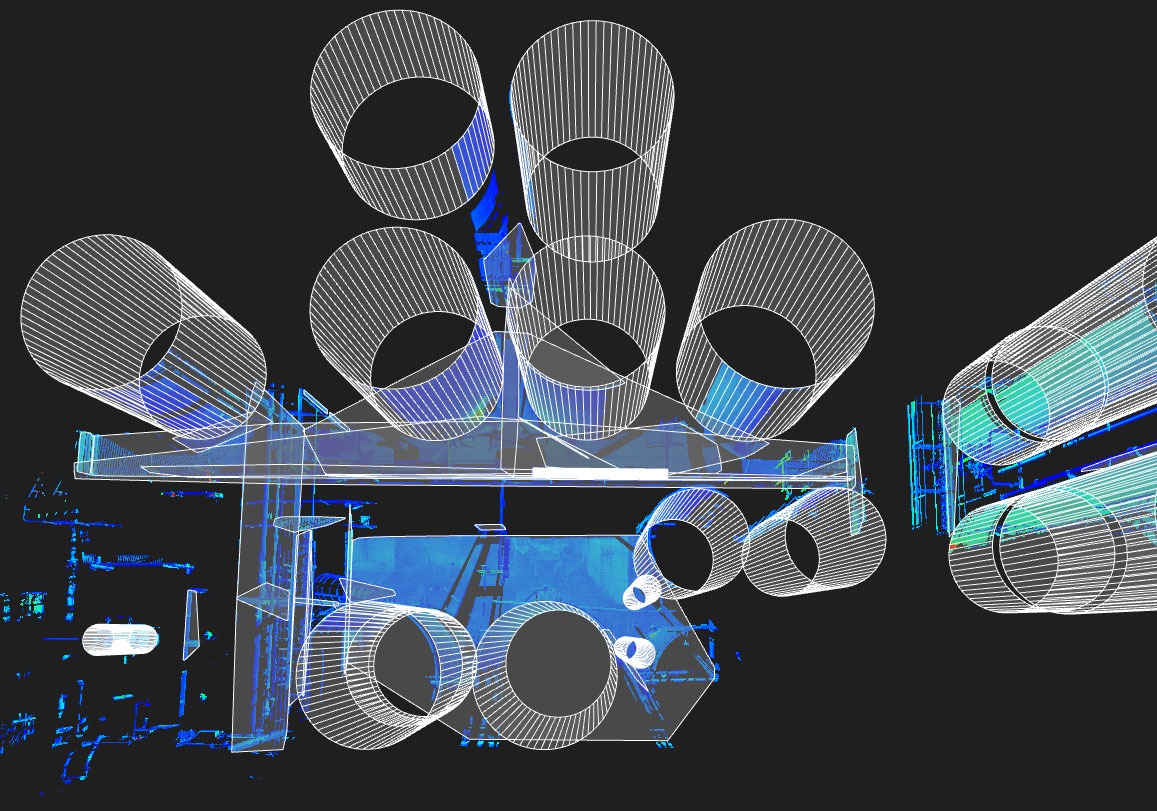
Feature-based registration aligns scans by detecting and matching geometric features such as planes and cylinders.
This method uses algorithms that detect planes and cylinders within individual scans. The detected shapes are then compared between neighboring scans and aligned. The algorithm recalculates the relative position of scans (rotation and translation) so that corresponding geometric features match as closely as possible, reducing alignment errors across the entire point cloud.
Advantages
-
faster preliminary alignment of neighboring scans
-
more stable in structured environments (e.g., industrial installations, production halls)
-
particularly effective in areas with repetitive geometry (e.g., tank farms)
Limitations
This method requires clearly identifiable geometric features in overlapping scan areas. It is therefore less effective in environments with smooth, uniform surfaces such as plain walls, empty halls, or open terrain with few identifiable objects. Its accuracy is also limited by the precision of feature detection and identification within the scans.
Target-Based Method
(registration using reference targets)
This method uses circular targets or spherical markers placed within the facility. Their coordinates are measured using a total station and tied to the facility’s control network. As a result, the registration process is mathematically controlled, and the entire point cloud is stably embedded in the global coordinate system.
Benefits
-
full mathematical control of the process
-
possibility of achieving global accuracy of 2–5 mm under favorable conditions
-
ideal for industrial projects requiring precise georeferencing
In the 3Deling system, this method is integrated with quality control procedures, allowing strict tolerances to be maintained even in very large projects.
Hybrid Approach – Control and Stability
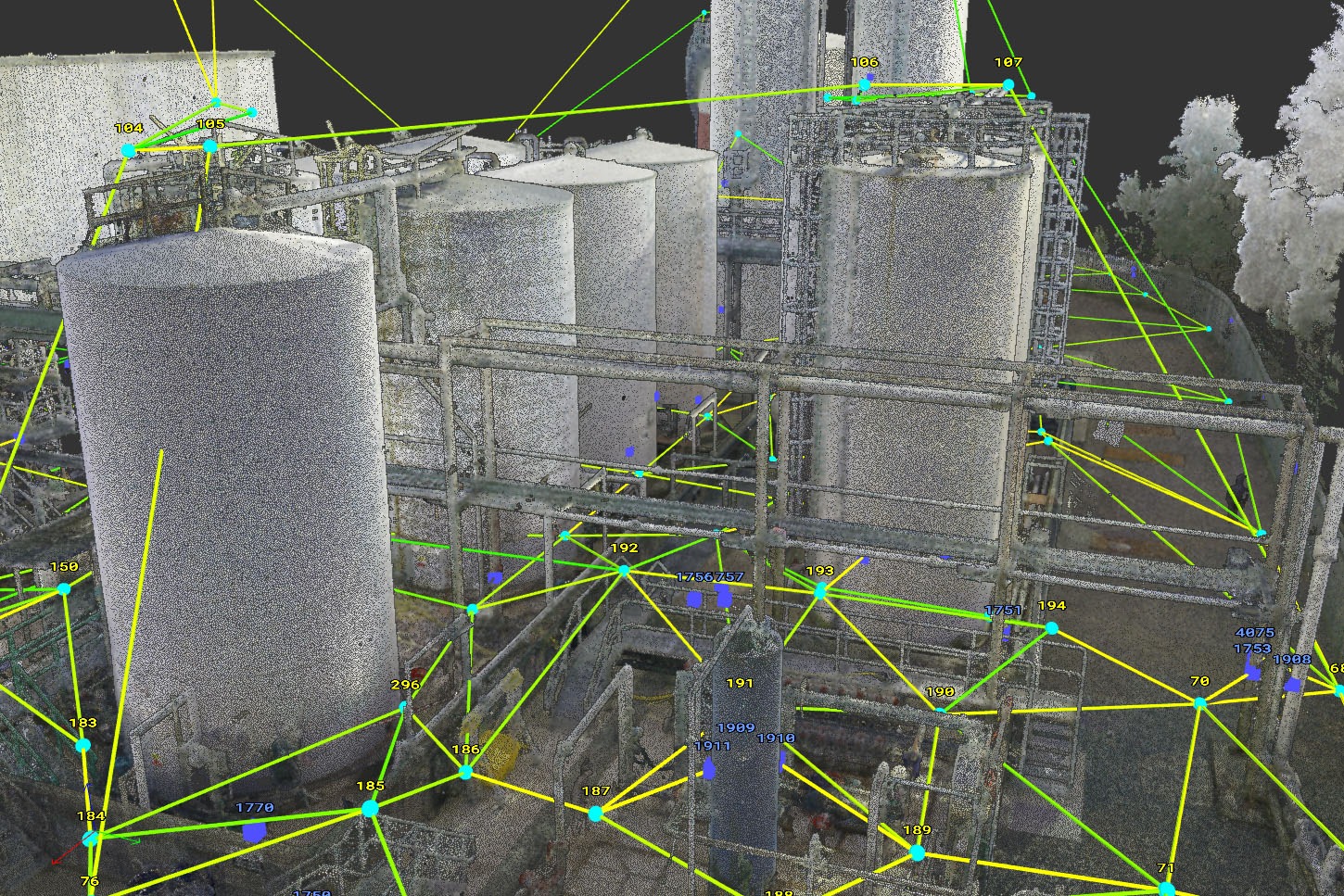
Visualization of the scan connection network used in hybrid point cloud registration within 3Deling software.
Combining these methods helps eliminate the limitations of standard scanner software. This approach ensures high-quality and consistent point cloud data even in projects involving extremely large areas and thousands of scan positions.
The Role of a Control Network
For large industrial facilities such as refineries, chemical plants, power stations, or petrochemical complexes, establishing a control network covering the entire site is strongly recommended.
Using total station measurements of control points and tying them to the control network:
-
anchors the point cloud in a global coordinate system
-
prevents error accumulation between scans, eliminating drift
-
maintains positional accuracy within a few millimeters
This is crucial for:
-
installation of new equipment
-
prefabrication of components
-
clash detection analyses
-
modernization of existing installations
Additionally, a geodetic control network enables scanning to be performed at different times (maintenance shutdowns, upgrades, deformation monitoring) while maintaining a consistent reference system. This makes it possible to build and update a complete as-built point cloud database for the entire facility over many years.
Quality Control and Reporting
The final point cloud undergoes multi-stage verification using proprietary 3Deling software. As part of the registration control process, the continuity and consistency of cross-sections and longitudinal sections are analyzed, and compliance with the defined accuracy requirements is verified.
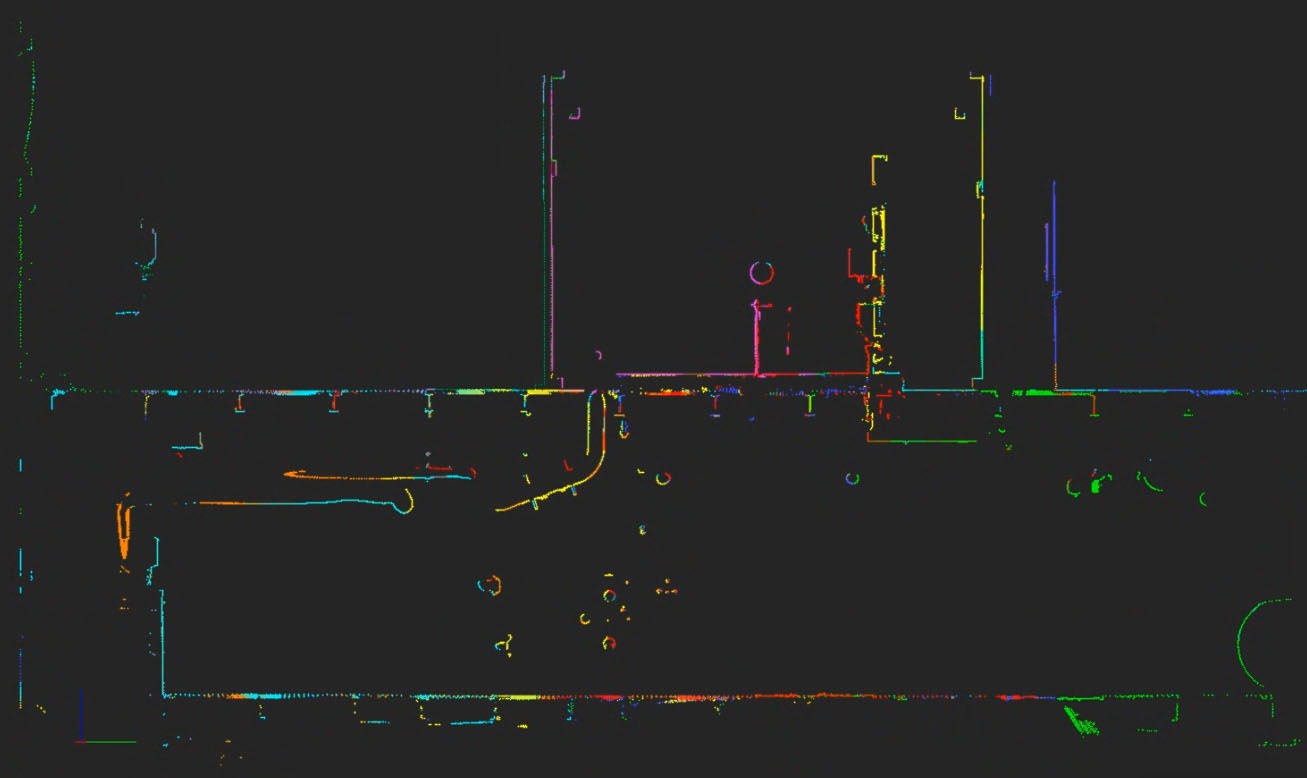
Cross-section through a registered point cloud used to verify alignment accuracy and continuity between scans.
The registration report includes, among others:
-
root mean square (RMS) error values for individual scan connections
-
deviations at control network points
-
translation and rotation errors for connections between scans (determined in global registration using control points and additional observations)
Transparency of these parameters forms the foundation of data reliability.
Summary
High accuracy of a registered point cloud is not merely a technical parameter. It represents real investment security and minimizes the risk of costly clashes during design, prefabrication, and installation.
Accurate as-built data ensures that:
-
new installations fit perfectly into the existing environment
-
modernization works proceed without unexpected conflicts
-
project schedules and budgets remain under control
Thanks to the use of a control network and proprietary registration tools, 3Deling ensures that data remains consistent and stable for years—even across multiple scanning cycles and facility expansions.