
Strategy and Goals – How to Avoid Overpaying for 3D Modelling
Many investors and project managers assume that a 3D survey must always end with a full, detailed CAD or BIM model. Engineering practice tells a different story: “more” does not always mean “better”, and it almost always means “more expensive”. The key to a successful project is matching the deliverable to the actual business objective – and asking that question before the first scanner is switched on.
The Business Objective as the Scope Driver
Defining project requirements precisely from the outset prevents the generation of unnecessary data, which has a direct impact on budget optimisation. The choice of deliverable should follow from its intended use:
Clash Detection
If the sole objective is to verify whether a planned installation will fit within an existing space, producing a full as-built model is rarely justified. A point cloud offers millimetre-level accuracy that is more than sufficient for detecting conflicts with existing infrastructure – including minor elements such as cabling and pipe supports.
It is worth noting that this approach works best for relatively straightforward spatial layouts and where the client or designer has someone on their team who is comfortable working with point cloud data. In more complex situations, or where that expertise is not available, a CAD model remains the safer choice.
Importantly, the data is available immediately after scanning – the Webpano platform allows the point cloud to be browsed, measured and interrogated in a web browser, without waiting for a finished model and without any specialist software. For more on how clash detection works using point cloud data, see here.
Project Documentation / As-Built
Full modelling – to CAD or BIM standard – is justified when the data will be reused across multiple engineering workflows: modernisation design, pipe spool prefabrication, multi-discipline coordination, or the development of a Digital Twin. In such cases, the investment in a complete model pays for itself through savings at later project stages.
Partial Requirements
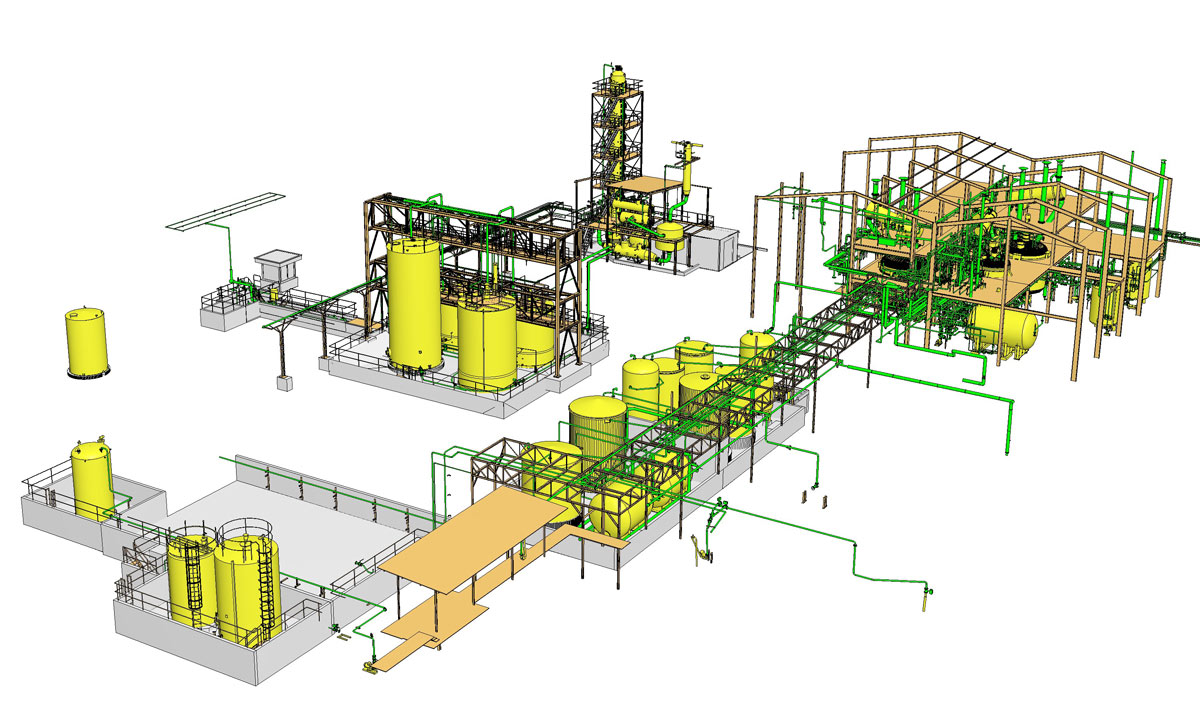
At 3Deling, we have developed an approach that avoids modelling what is not needed. When only a specific section of a plant is being modified, modelling the entire facility is wasteful. The sensible choice is a partial model covering only the area or discipline directly relevant to the planned works. An incremental model – developed progressively alongside successive phases of the investment – is also worth considering. This too is an approach developed by the 3Deling team: the model grows alongside the project and the client’s budget.
Selective Modelling – Minimum Data, Maximum Functionality
Selective modelling focuses exclusively on the elements needed to complete a specific engineering task. Rather than representing the entire installation, only what is genuinely required is modelled – pipelines above a certain bore, key junctions and nozzles, selected pipe supports, equipment scheduled for replacement, larger vessels such as tanks and reactors, or zones immediately adjacent to the planned works.
This approach delivers measurable benefits on several levels. The model is cleaner and easier to analyse, free from unnecessary “information noise”. Delivery times are shorter. And most importantly – the budget stays under control.
It is also worth remembering that the point cloud remains available as a full spatial reference for the entire facility. Only selected elements are modelled, while the rest of the plant exists as a precise point cloud – ready for measurement and analysis at any time.
Iterative Modelling – Spreading Costs Over Time
A limited budget or tight schedule does not mean settling for a point cloud alone. Iterative modelling allows costs to be spread over time, with the model developed incrementally as the project progresses and funding becomes available.
The process runs in two main stages:
The Two Stages of Iterative Modelling
Stage 0 – Solid CAD Model: The starting point is a model built from simple geometric primitives – cylinders, cuboids, cones – that accurately represents the geometry and spatial position of the installation’s components. The model does not yet carry technical attributes or process logic. In terms of effort, Stage 0 accounts for roughly half of the total work involved in producing a full intelligent model. There is also an important technical consideration: modelling must follow a strict geometric discipline. Using inappropriate solid types or tools can result in the geometry being converted to a mesh on import into a CAE environment – making it non-editable and unusable for further design work. It is also worth noting that not every element is modelled as a solid at this stage – catalogue components such as elbows are drawn from predefined libraries at Stage 1.
Stage 1 – Intelligent Model: The solid CAD model becomes the framework onto which specifications, technical attributes and process logic are applied in industrial-grade systems such as AVEVA E3D. Each element of the installation receives its own “data sheet” – line number, material specification, operating parameters, links to technical documentation. The model moves beyond spatial representation and becomes an intelligent technical database of the facility.
The key advantage of this approach is continuity. The geometry created at Stage 0 is not discarded or rebuilt from scratch – it forms the foundation on which Stage 1 is developed. It is worth bearing in mind, however, that an information gap often appears between the two stages: populating the model with technical attributes requires data from the client’s own subject matter experts – specifications, line numbers, material classes. The Webpano platform can serve a practical role here as a communication tool, allowing specific elements to be identified directly within the model or point cloud so that missing information can be gathered before Stage 1 begins. More broadly, Webpano gives designers, subcontractors and maintenance teams remote access to scans and models directly in a web browser – no specialist software required, from anywhere in the world. This approach – developed by the 3Deling team drawing on experience from process industry projects – allows the model to be built out at precisely the pace the budget, schedule and data availability allow.
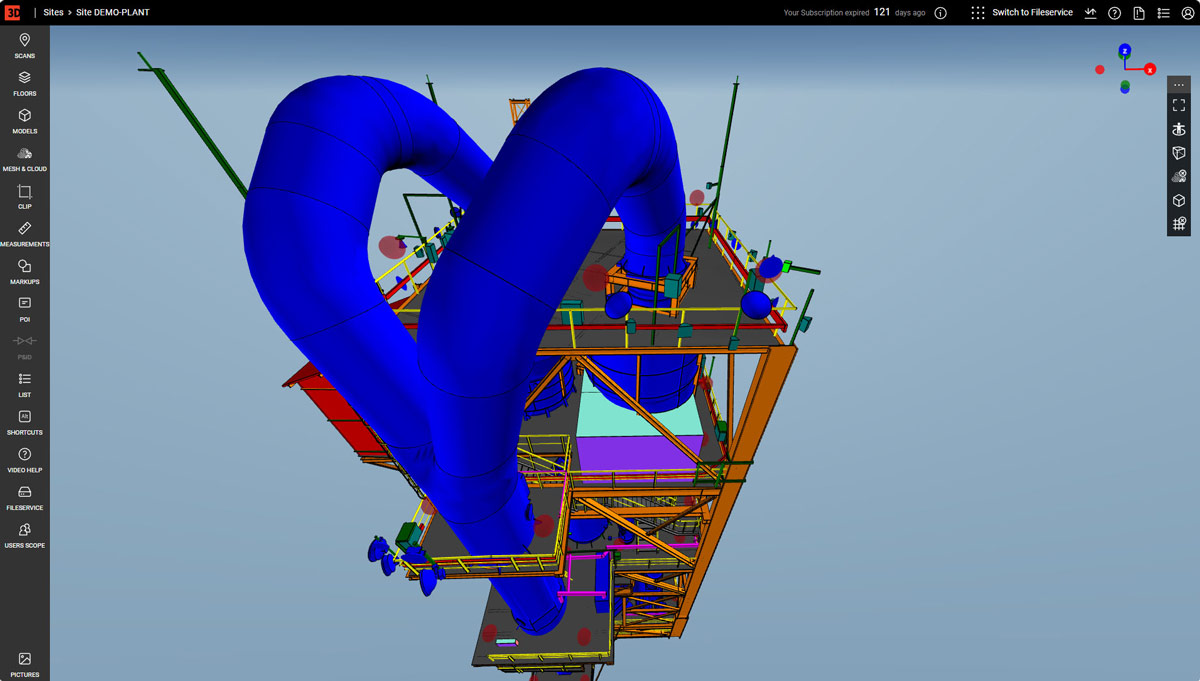
webpano 3d model browser view 3deling
The Foundation of Every Survey
Regardless of the modelling scope chosen, the quality of the final deliverable depends on the quality of the input data. A properly established geodetic control network and a complete, accurately registered point cloud have a significant bearing on the quality of the end product – the more reliable the input data, the more accurate and useful the model. These topics are covered in detail in the previous article series:
Control Network – the Foundation of a Digital Twin of an Industrial Plant
Data Quality in 3D Scanning: Why the Number of Scans Matters More Than Resolution
Accuracy of a Registered Point Cloud – The Foundation of Reliable 3D Surveying
A strategic approach to 3D modelling is, above all, about making conscious decisions on data scope. Selective or staged methods allow maximum functionality to be delivered while keeping project costs under control.
Next article: Not every 3D model is a CAD model – a distinction that could cost you.
Want to find out which modelling strategy will work best for your project? Get in touch – our experts will assess your requirements and put together a tailored proposal.