
In previous articles, we explained how data quality is influenced by the control network, the number of scans, and the accuracy of the registered point cloud. All these elements serve one purpose – to obtain a reliable geometric representation of the object.
The next step is data processing, and one of its most common outputs is the mesh model. This is the type of model most often used in presentations, web environments, and spatial analyses. At the same time, this is the stage where the quality achieved during data acquisition can easily be lost.
Before we go further, there’s one distinction worth making clear — one that causes confusion more often than you’d think: mesh is not CAD, and this difference has very real practical consequences.
A mesh model is a surface recorded as a network of polygons. Even a high-quality mesh remains a “net” — it carries a large amount of data, is difficult to edit directly, and without significant decimation can be too heavy to work with comfortably in CAD software. Its main advantage is low acquisition cost and faithful representation of physical reality.
A CAD model works on an entirely different principle: geometry described mathematically, lightweight, and fully editable. A well-built CAD model based on solid primitives can be imported directly into CAE environments such as AVEVA. The trade-off is time and effort — CAD modelling is a manual process, which makes it considerably more expensive.
Both approaches have their place and purpose — but they are not interchangeable.
A Mesh Model Does Not Appear “Out of Nothing”
A mesh model is created by connecting points into triangles that form continuous surfaces. To do this, algorithms must identify relationships between points and reconstruct surface continuity.
A key concept here is surface normals – vectors that define the orientation of a surface.
For a mesh to be accurate:
- the same areas must be captured from multiple viewpoints,
- the data needs to be geometrically consistent,
- surfaces cannot be defined from a single direction only.
This creates a direct dependency on how the data was captured. If scan coverage is insufficient, the mesh simply does not have enough information to reconstruct the geometry correctly.
Missing Data Doesn’t Go Away – It Gets Hidden
In a point cloud, missing data appears clearly as gaps.
In a mesh model, algorithms often attempt to fill these gaps by interpolating surfaces, closing geometry, and smoothing discontinuities. The visual result may appear coherent, but it does not guarantee geometric accuracy.
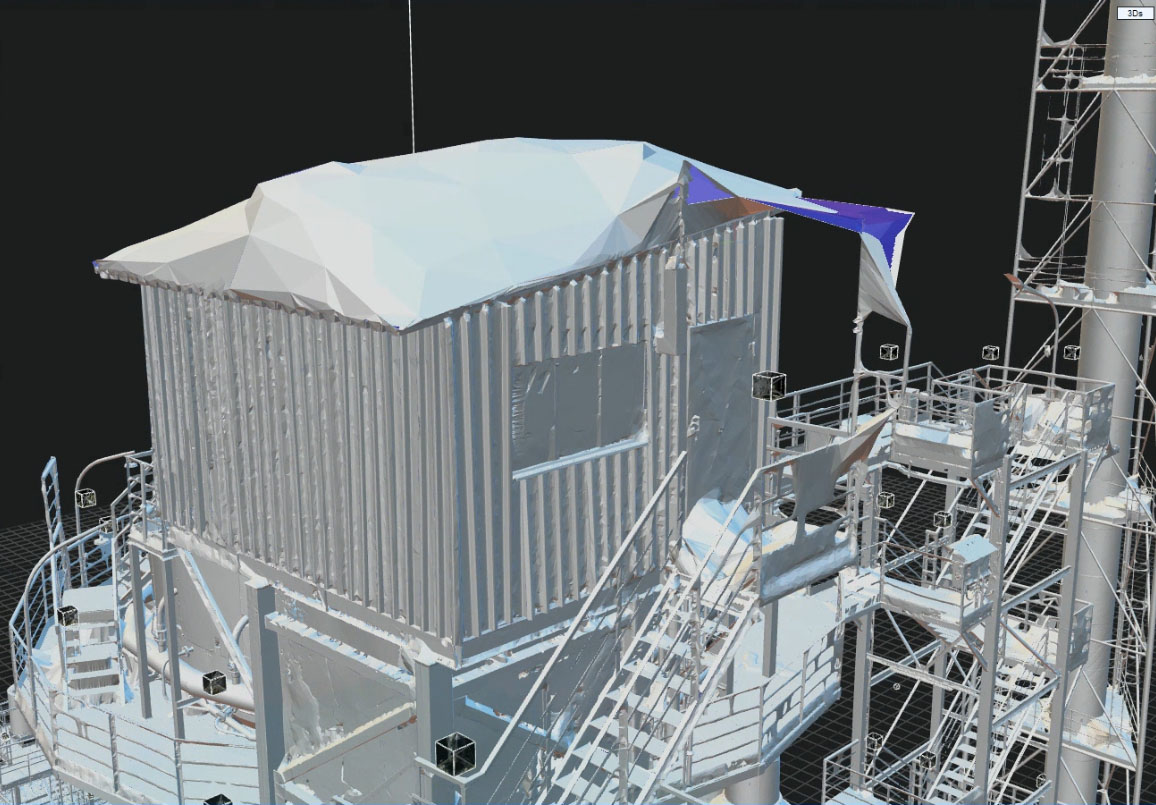
Mesh artifacts generated by reconstruction algorithms in areas with missing data – example on a roof surface
As a result:
- surfaces may appear where none exist in reality,
- details may be simplified or shifted,
- the model loses its value as a reliable data source.
For this reason, automatic hole filling should be used carefully and under control.
Point Cloud Cleaning – A Critical Step for Quality
Before generating a mesh model, the point cloud must be properly prepared.
This includes:
- removing noise,
- eliminating erroneous points (e.g., caused by moving objects),
- filtering out irrelevant elements.
This process is not fully automated in many cases and often requires manual work and experience.
If noise remains in the data, it will be embedded in the mesh as geometric artifacts.
Color and Texture – An Often Overlooked Quality Factor
Mesh models are often enhanced with textures, which significantly improve readability.
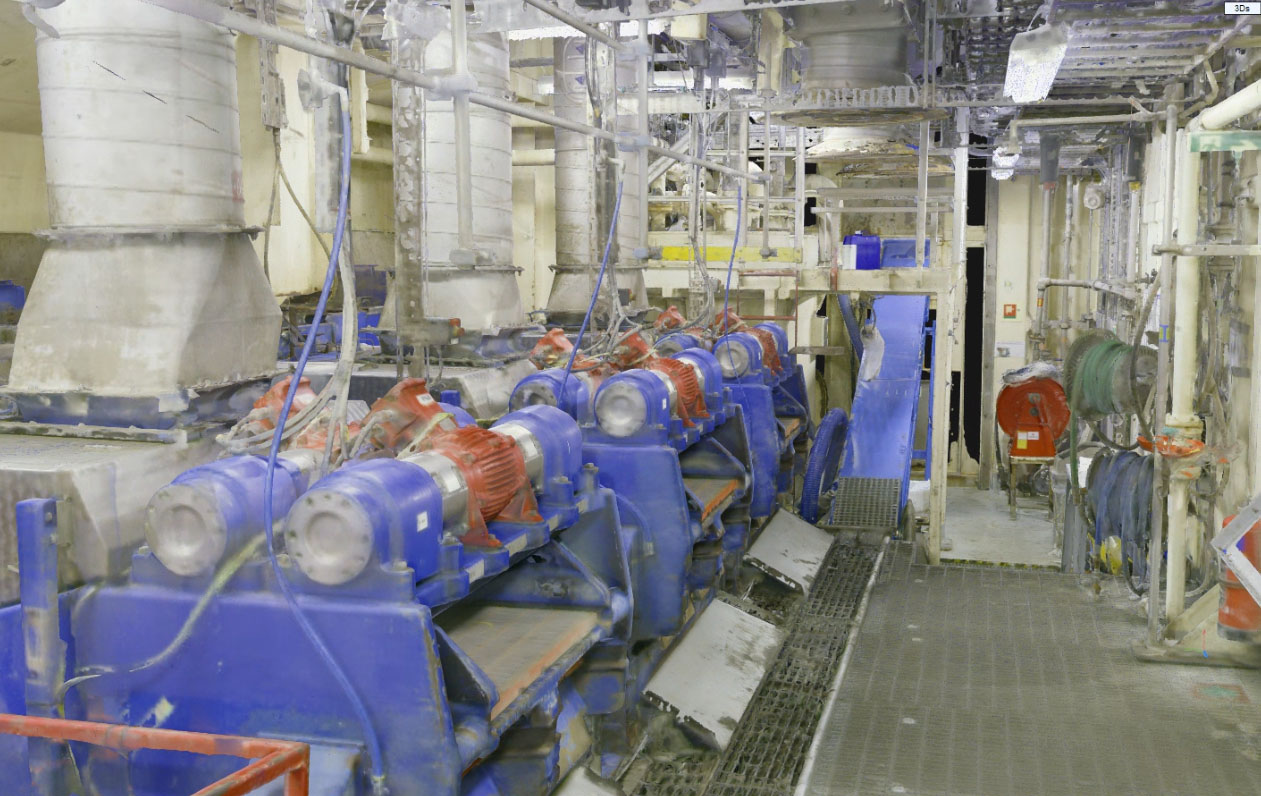
Textured mesh model of industrial installation – improved readability compared to non-textured geometry
However, texture quality depends heavily on capture conditions. Uneven lighting, harsh shadows, or changing weather can introduce inconsistencies.
The best results are typically achieved under uniform, diffused lighting conditions – for example, on an overcast day.
Texture resolution also needs to be carefully managed. Highly detailed textures can significantly increase file size without delivering proportional value.
Combining Data Sources – Laser Scanning and Photogrammetry
In many projects, the best results come from combining different data sources.
Laser scanning provides accurate geometry, while photogrammetry contributes high-quality visual detail. Photogrammetric images are usually captured within a short time frame and under consistent lighting conditions, often using higher-quality cameras than those built into scanners.
This results in more consistent and detailed textures, improving the overall readability of the mesh – particularly in areas that are difficult to scan.
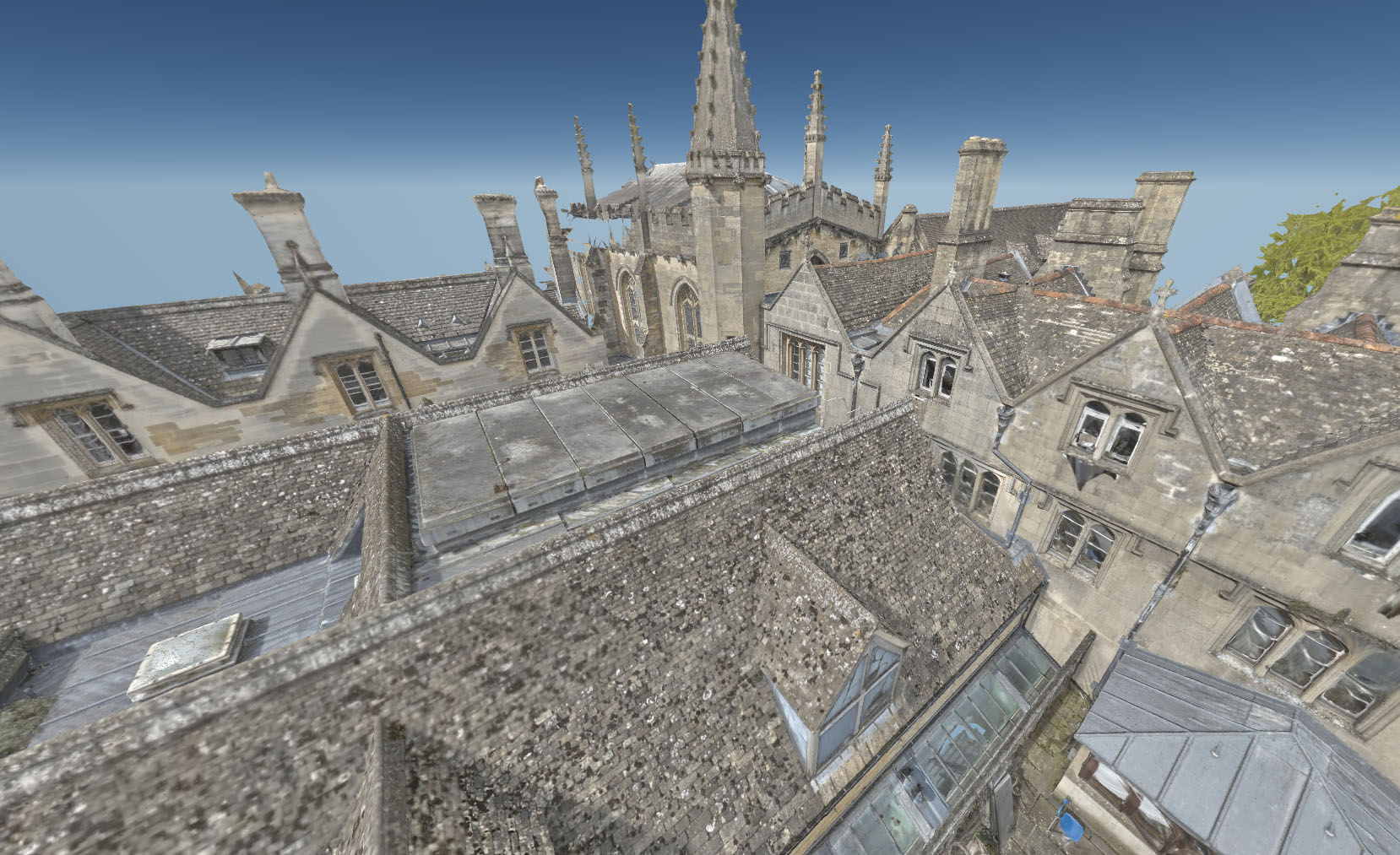
Mesh generated from drone photogrammetry – high-quality textures and good results for simple building geometry
It is also worth noting that mesh models can be created entirely from photogrammetry, without laser scanning. This approach is widely used, especially for buildings and terrain.
It performs well for volumetric objects with relatively simple geometry, where flat surfaces such as walls and roofs dominate. In these cases, photogrammetry can deliver both good geometry and high visual quality.
However, for objects with complex geometry – such as industrial installations – its limitations become apparent. A high level of detail, cylindrical elements, occlusions, and irregular shapes make geometric reconstruction less stable and less reliable.
Mesh Optimisation – Finding the Right Balance
Raw mesh models can contain a very large number of triangles, which makes them difficult to work with.
To make them usable, optimisation is required, including:
- triangle reduction (decimation),
- geometry simplification,
- texture optimisation.
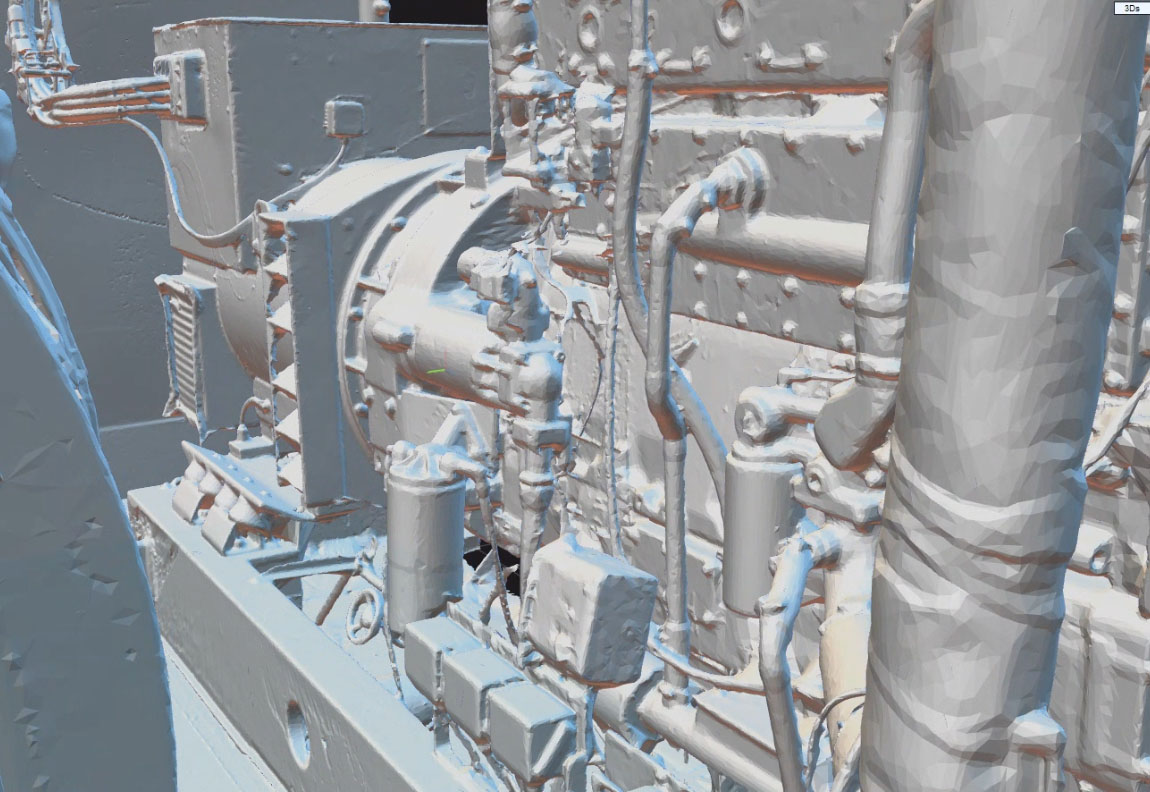
High-resolution mesh detail without textures – geometry is visible but harder to interpret visually
The goal is to strike a balance between detail and performance. A model that is too large becomes difficult to handle, while excessive simplification leads to loss of important information.
Mesh Quality Depends on Input Data
A mesh model can only represent reality as well as the input data allows.
Its quality improves with:
- the number and distribution of scans,
- completeness of object coverage,
- reduction of occlusions,
- consistency of the point cloud.
For large-scale objects with complex geometry or many occlusions, the model becomes more dependent on reconstruction algorithms. This may lead to artificially closed surfaces, geometric simplifications, and loss of interpretability.
Summary
A mesh model is a powerful tool, but its quality is not created during modelling.
It is determined by:
- how the data was captured,
- the quality of the point cloud,
- the completeness of the dataset,
- the processing workflow.
Decisions made at the beginning of a project ultimately define whether the final model is a reliable representation of reality or just a simplified approximation.
Building a Digital Twin of an Industrial Facility?
At 3Deling, we support clients at every stage of digitalisation – from planning data acquisition and establishing control networks, through 3D laser scanning, to preparing data for modelling and visualisation.
In projects where data reliability matters, quality must be built in from the very beginning.
Feel free to get in touch to discuss your project.